

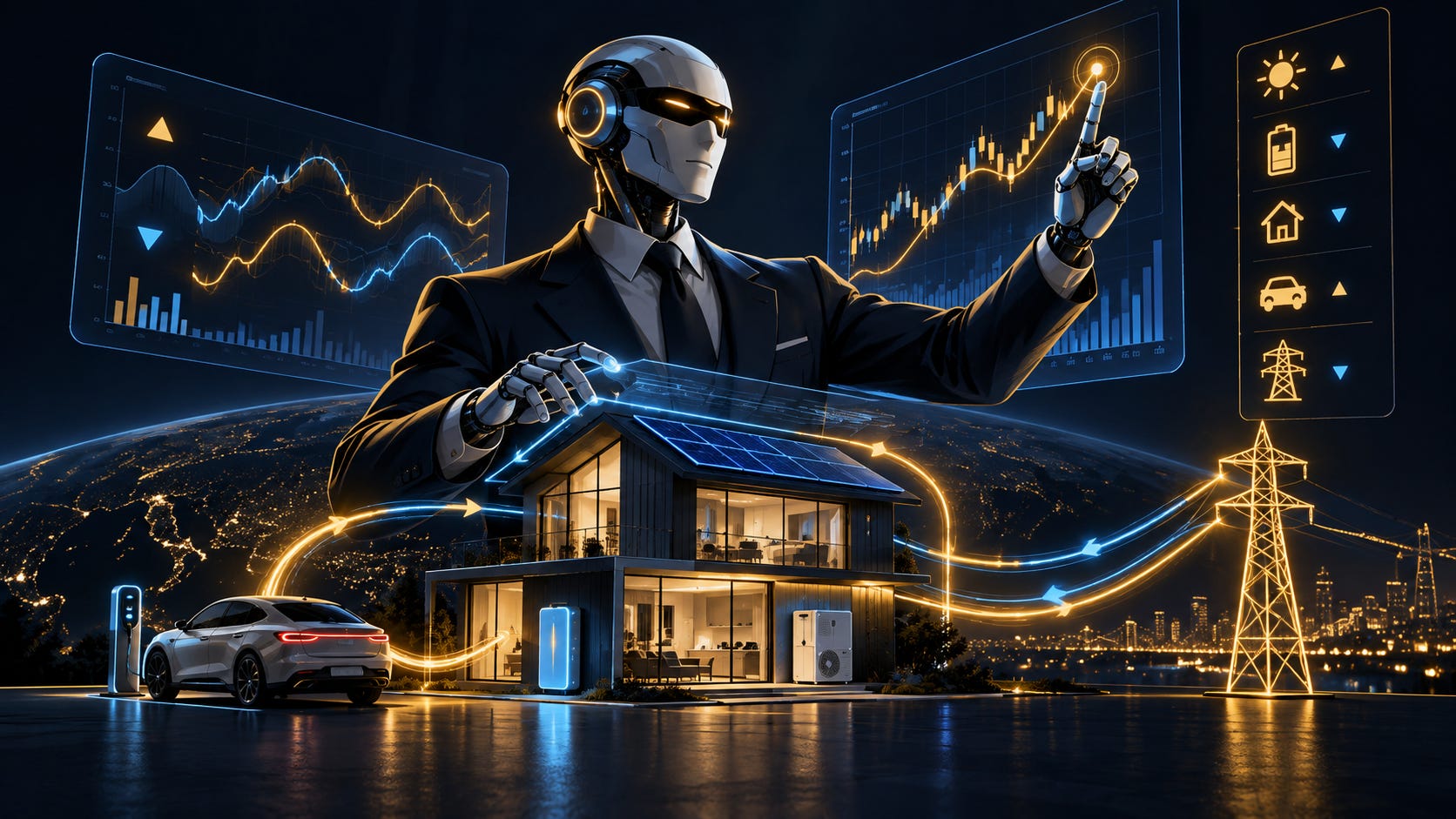
PG&E, Rewiring America, and Google just launched a first-of-its-kind virtual power plant (“VPP”) which aims to turn home appliances into a new form of energy supply for the grid. The newly launched SHARE program, short for Smart Home Assets for Reliability and Efficiency, is an effort to capture latent energy in household appliances. In other words, your water heater might just become a revenue-producing asset.
Here’s how:
Think of SHARE as pooling thousands of homes into one giant, software-controlled power plant. Instead of PG&E relying only on centralized generation when demand spikes, it can tap into energy already sitting inside homes: batteries can discharge, thermostats can ease off for a bit, and other flexible loads can shift to a different time.
To the homeowner, most of this should happen quietly in the background. You set the boundaries, software handles the timing, and in exchange your home can earn incentives for being available when the grid needs help. The key idea is that your house is no longer just consuming electricity; parts of it can now actively participate in the energy market.
Near-term Implications:
In the near term, this gives utilities another way to handle surging electricity demand without solving every bottleneck by building more power plants, transmission lines and substations. Instead, some additional grid capacity can come from equipment that already sits inside people’s homes. PG&E is explicitly testing whether targeted investment in household equipment can unlock capacity on the regional grid.
For homeowners, the bigger shift is conceptual: your appliances are starting to become economic assets. A battery can sell flexibility to the grid. A heat pump can decide when energy is cheapest to consume. An EV can eventually act as both transportation and energy storage. As more devices become connected and controllable, the house starts looking less like a collection of dumb appliances and more like a portfolio of assets managed by software.
What the Future May Hold:
Imagine a home ten years from now that behaves less like a collection of appliances and more like a small autonomous economy.
Your house knows the price of electricity in real-time. It knows how much energy is sitting in the home battery, the EV in the garage, the water heater, and whatever storage devices come next. It also knows your plans. Maybe you’re taking the family up to Napa for the day, which means the car needs to leave at 9:00AM with enough range for the drive, lunch, a few winery stops, and the ride home.
So, the house works backward from that.
Overnight, it waits to charge the EV until power is cheapest. By morning, the car is ready, the home battery has enough reserve for the day, and the water heater has already done most of its work. While you’re in wine country, rooftop solar keeps filling the home battery. By late afternoon, electricity prices spike, so the house sells some of that stored power back to the grid.
You come home at 7:30PM. The car still has 35% battery left. Your home agent knows you’re not going anywhere until morning, so it decides that some of that remaining vehicle energy is more valuable supporting the house for the next few hours than sitting idle in the garage.
You don’t manage any of this. Your home AI does.
Go a little further out and things get stranger. Your home might choose between competing energy markets, coordinate with neighboring houses, decide when to buy versus store versus sell, or summon an autonomous vehicle based partly on the energy it carries. A neighborhood could behave like a decentralized power plant made up of homes, cars, batteries, HVAC systems, and appliances.
At that point, the house is no longer simply connected to the grid.
It is a participant in it.
.